


Authors: Harshdeep Singh Jen Gee Chan Sundararajan Subramanian Sean Ashley Omar Bourgoub Mike Groseclose Deepanjali Vashishtha and Jubin Chheda
Large organizations need the right information to reach the right person at the right time so they can act on it.
It’s hard to do this well at scale, which leads to:
- Decision latency. Project updates are generally reviewed at each layer in the org hierarchy. It takes them a while to go up the chain, where some of the hard calls can be made.
- Cascading risks. Projects across the org are connected in a myriad of ways, not all of them explicitly accounted for. Second- and third-order consequences of a slip are often unknown until they happen.
- Execution drift. Strategy mutates over time. Sometimes it’s intentional. Often it just happens as people interpret things differently.
A lot of time and effort has gone into solving these problems. But the solutions—often leaning towards better dashboards—have been reactive. They answer questions someone already thought to ask.
Rhythm aims to invert that with anticipatory intelligence (example shown in Figure 1).

Rhythm’s key principles
- Anticipatory intelligence: Surface issues before they become problems. Track commitments without being asked. Maintain organizational context that typically requires dedicated human effort.
- Low-latency communication: Minimize the time it takes for information to flow through the org. Our goal is that as soon as a decision is made or code is pushed, everyone has access to how the product has evolved.
- Scale through a single owner: One person creates and maintains the project, and the knowledge is available to everyone else. Provide consistent visibility and support for all prioritized projects across all levels of an organization and across cross-functional stakeholders.
How Rhythm works
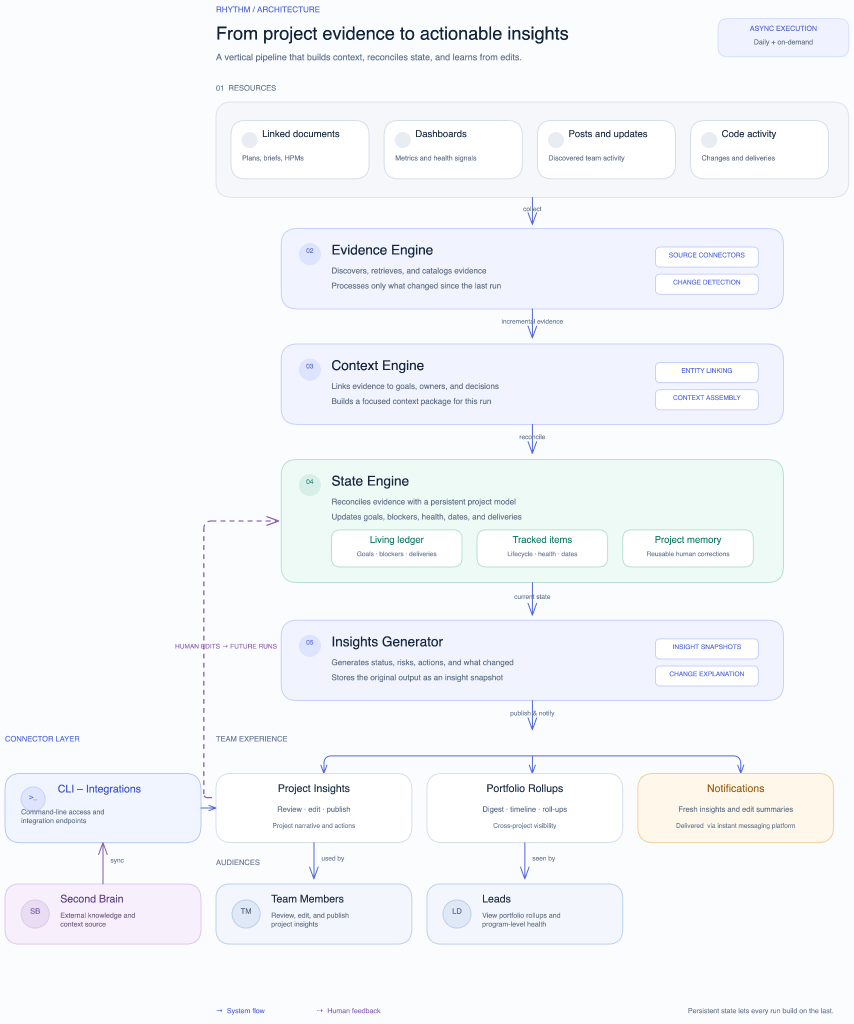
Rhythm turns scattered project signals into a structured, living view of execution. It organizes evidence from linked sources into a durable project state, then uses that state to generate insights. This entire flow is illustrated in Figure 2.
Rhythm works in four steps:
- Collect the sources. Rhythm catalogs every document, experiment, and post that the project owner has linked. For each source, it records where it lives, what kind of artifact it is, and when it last changed. If a source hasn’t changed, Rhythm reuses its earlier synthesis from that source; if it has, Rhythm processes it again.
- Turn sources into project facts. A model identifies the useful parts: goals, milestones, experiments, blockers, decisions, launches, and risks. Rhythm saves these as distinct project records. New evidence is added to the history instead of overwriting it, making it possible to see how a decision, risk, or milestone changed over time.
- Prepare the facts before insight generation. Rhythm then assembles a current view of the project’s status, priorities, milestones, and risks. It determines which sources each item may cite, removes duplicates, and filters out evidence that is too old for its source type. By the time insights generation begins, every supported point already has a path back to its source.
- Generate and save the insight. The model turns that prepared view into a plain-language insight. Rhythm saves each run as a new version, together with its citations, any sources it couldn’t access, and its approval state. When a person corrects an insight, it’s captured as learning. During the next generation, these learnings take precedence unless explicitly overridden by a new fact.
Measuring source quality
A Rhythm insight is only as useful as the sources behind it. The source-quality score, from 0 to 100, shows whether Rhythm has enough reliable project information to work with.
- Accessibility (35 points): Can Rhythm open the linked sources?
- Completeness (30 points): Is there enough information to support an insight?
- Coverage (20 points): Are different source types represented?
- Freshness (15 points): Have the sources been updated recently?
Accessibility has a higher weightage because there is more information that is available but just not accessible to Rhythm, which has more impact on the quality. Rhythm uses the score to flag missing, inaccessible, or stale sources and recommend what to improve. It measures the quality of the inputs—not whether the generated insight is correct.
Citations
Citations turn a Rhythm insight from an assertion into something people can verify. By linking each status, risk, or recommendation to the project artifact that supports it, Rhythm lets readers inspect the original context, confirm that the source is current, and understand how the insight was derived. This builds trust, speeds up decision-making, and gives owners a clear path to correct incomplete or outdated information.
Preserving information boundaries
One of the engineering challenges was preserving information boundaries. Useful project information often lives in internal documents, team chats, and restricted strategy decks. Rhythm needs access to that information without sharing it with people who do not need to see it.
The problem with ambient extraction: When a system analyzes internal files, broad summaries can inadvertently expose sensitive details. Standard document permissions are insufficient when synthesized insights combine multiple sources. This means that the access restrictions of individual sources should accurately reflect itself in the synthesized insights too.
Five principles for AI information access
- Preserve access boundaries. An insight must never reach a broader audience than its sources unless an authorized owner explicitly reviews and promotes it.
- Authorize every read. Both the requesting user and Rhythm must be permitted to access every input; uncertain access fails closed.
- Bound synthesis. An insight combining multiple sources may be shown only to people authorized for all of them. If that audience cannot be verified, the insight is not published.
- Do not escalate persistence. A chat remark, internal meeting comment, or draft does not become a durable project fact without explicit, scoped review.
- Make every insight auditable. Stored insights retain their source provenance, sensitivity, approval history, and intended audience.
For example, suppose a Meta-wide, product-requirements document (PRD) says a launch is planned for October. A restricted strategy document says it depends on an unannounced partnership, while a five-person chat suggests the date may slip.
Rhythm publishes the October date from the PRD, excluding both the unannounced partnership for public viewers and the chat remark about schedule slippage. Every published statement identifies the source that supports it. This will be available as enhanced insight only for viewers with access to this information.
How Rhythm enforces the five principles
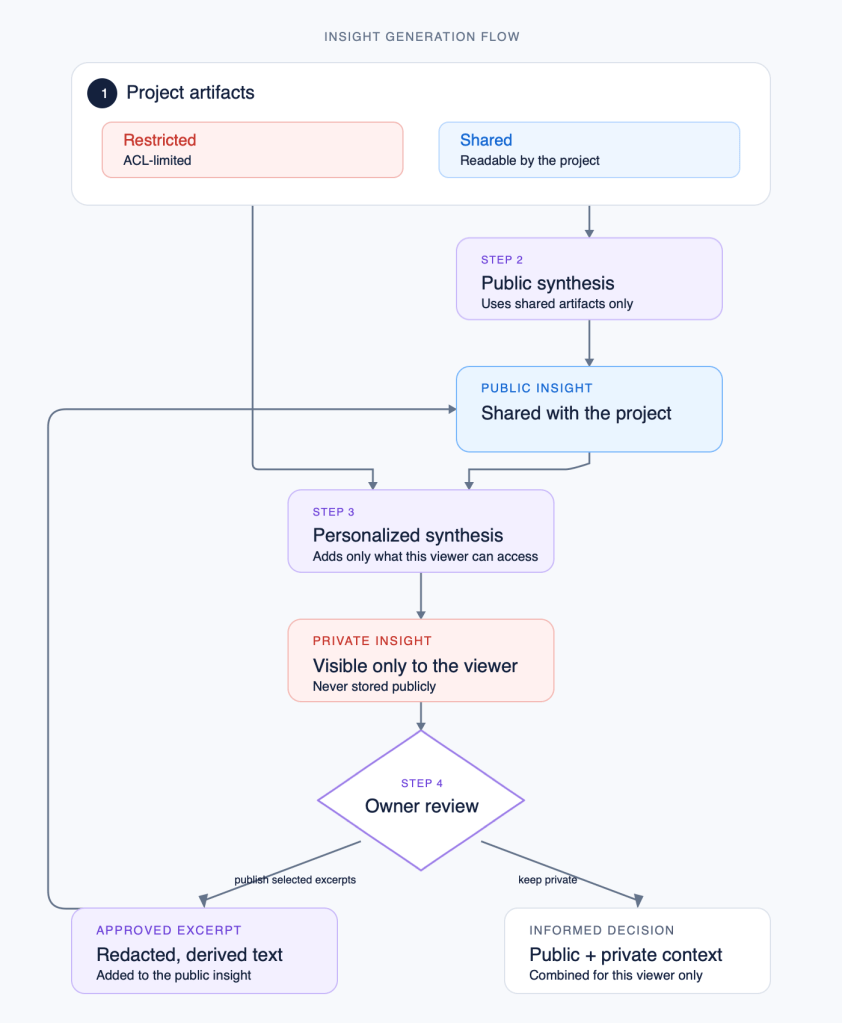
Rhythm enforces these five principles by first generating the public insights and then starting to create the per-viewer enhancements as illustrated in Figure 3. Per-viewer enhancements may use additional sources that the viewer is already authorized to read.
- Classify artifacts: Every project artifact is either public (all members) or restricted (explicit access-control list, or ACL).
- Generate the public baseline: The generator reads only public artifacts. Output may be published project-wide.
- Generate per-viewer enhancements. For each user, baseline plus only the restricted artifacts that the user can already read. Rendered for them alone, never persisted publicly. No internal document gets published.
- Owners decide: Promote a reviewed/redacted portion into the public insight, or do not share it and act on the combined picture.
The insights visibility is summarized in Table 1.
Evals
One of the main problems in the early days of insights was that they did not accurately reflect the product owner’s view. That could have been a result of the inaccurate status, the way it’s written, missing other important information, or the staleness of some decisions. This resulted in owners editing portions of insights or even rewriting them fully.
We built a repeatable eval framework to test whether Rhythm’s insights accurately reflect their sources and help people act. Nine LLM rubric judges assess quality—including factuality, freshness, prioritization, and citation accuracy—while seven reliability checks catch failures such as unexplained status flips, invented statuses when data is missing, and dropped uncertainty.
In addition, we built an edit-learning pipeline where our system classifies edits as cosmetic or critical. For each critical edit, a learner classifies what Rhythm could have done better versus any additional sources the user could have provided. Based on this, Rhythm updates its configs and prompts to self-improve. This resulted in the critical edit rate dropping from 26% to 6% over three weeks.
Results
Over time, Rhythm has replaced manual weekly status updates for organizations inside Meta. Rhythm serves 200+ projects and continues to grow in its adoption. It now assists with information flow on key projects, execution, upcoming risks, and faster hard decisions. The canonical project record has also enabled teams to build tools on top of Rhythm for prioritization, execution, and operations.
What’s next
Rhythm keeps getting better at understanding how the organizations work. It’s evolving beyond status tracking to actively protect an organization’s strategic vision. Future iterations will focus on making Rhythm a high-agency team member proposing proactive solutions, nudging stakeholders, and executing low-hanging remediations across connected workflows.

